

An unfortunate accident caused one of the biggest fires that the City of Seattle had ever seen in the 1880’s, almost nearly losing most of its downtown district. This caused Seattle to react and become better prepared to shift their volunteer firefighters to a paid fire department. Today, it is one of the biggest departments in the State of Washington.
The Creation of Seattle
In the fall of 1851, the Denny Party arrived at Alki Point in what is now the state of Washington. After spending a miserable winter on the western shores of Elliott Bay, the party relocated to the eastern shores and established the settlement that would become Seattle.[1] Early Seattle was dominated by the logging industry. The combination of a safe bay and an abundance of coniferous trees made Seattle the perfect location for shipping lumber to California. In 1852, Henry Yesler began construction of the first steam-powered mill in the Pacific Northwest.[2] Because of the easy access to lumber, nearly every building was constructed of the affordable, but combustible timber. Additionally, because the area was at or below sea level, the fledgling town was a frequent victim of massive floods, requiring buildings to be built on wooden stilts. The town also used hollowed out scrap logs propped up on wooden braces as sewer and water pipes, increasing the combustible loading.
Cause of Fire
On the afternoon of June 6, 1889, John E. Back, a worker in Victor Clairmont’s cabinet-making shop near Front Street and Madison Avenue, was heating glue over a gasoline fire. Sometime around 2:30 pm, the glue boiled over and caught fire. The fire soon spread to the wood chips and turpentine covering the floor. Back attempted to douse the fire with water which only served to spread the fire further.[3] The fire department arrived by 2:45, but by that time the area was so smokey that the source of the fire could not be determined. At first it was assumed to have begun in the paint shop above Clairmont’s woodworking shop and the Seattle newspaper erroneously ran this story the next day.[4][5
Fire Spreads…
Fed by the shop’s timber and an unusually dry summer, the blaze erupted and shortly devoured the entire block. The fire quickly spread north to the Kenyon block and the nearby Madison and Griffith blocks.

Unprepared. No Resources to Respond.
A combination of ill-preparedness and unfortunate circumstances contributed to the great fire. Seattle’s water supply was insufficient in fighting the inferno. Fire hydrants were sparsely located on every other street, usually connected to small pipes.[6] There were so many hydrants in use during the fire that the water pressure was too weak to fight such a massive blaze. Seattle also operated by a volunteer fire department, which was competent, but inadequate in extinguishing the fire.
Damage Causes Huge Losses
By the morning of June 7, the fire had burned the majority of 32 city blocks, including the entire business district, four of the city’s wharves, and its railroad terminals.[7] The fire would be called the most destructive fire in the history of Seattle.[8] Despite the massive destruction of property only one person was killed by the fire, a young boy named James Goin. However, there were also fatalities during the cleanup process. Total losses were estimated at nearly $20,000,000.[9]
Seattle Rebuilds
Despite the magnitude of destruction, the rebuilding effort began quickly. Rather than starting over somewhere else, Seattle’s citizens decided to rebuild.
Seattle rebuilt from the ashes with astounding rapidity. The fire had done a fine job of cleansing the town of rats and other vermin. A new building ordinance resulted in a downtown of brick and stone buildings, rather than wood.
Volunteer to Paid Fire Department Shifts
The city made many improvements in response to the fire. The city’s fire department shifted from a volunteer to a paid force with new firehouses and a new chief. The city took control of the water supply, increasing the number of hydrants and adding larger pipes.[6] The advent of brick buildings to downtown Seattle was one of the many architectural improvements the city made in the wake of the fire. New city ordinances set standards for the thickness of walls and required “division walls” between buildings.[12] These changes became principal features of post-fire construction and are still visible in Seattle’s Pioneer Square district today, the present-day location of the fire. At Pioneer Square, guided tours are also available to paying customers. Also at this location visitors can tour the Seattle Underground, where they can visit remains of buildings that were built over after the fire.
Seattle Fire’s Beginning of Time, A Historical Moment.
Seattle’s Fire Department was established by City Charter in 1883. The charter provided for equipment purchases, but not for hiring of firefighters. Following the Great Seattle Fire of 1889, a professional fire department was created with five district fire stations. A fire boat was also purchased. The first Fire Chief of the professional department was Gardner Kellogg, who served from 1890 to 1892 and again from 1895 to 1901. A Board of Fire Commissioners was established by the 1890 City Charter to prescribe rules and regulations for the Department. The Board’s responsibilities included enforcing rules violations and appointing the Fire Chief and all subordinate officers. The Board was abolished with passage of a new City Charter in 1896.[1]

On July 30, 1914, engine companies and fireboats, including the Duwamish, fought the fire at the Grand Trunk Pacific dock. One fireman from Engine Company No. 5 was killed and 10 others were hurt.
STATIONS OF PAST


NOTABLE FIRES


- Municipal Market Fire – known now as the Pike Place Market on September 23, 1974. (Courtesy: Seattle Municipal Archived Photograph Collection)


FIRES IN THE 1990’S
Serial Arsonist – Paul Keller
From the summer of 1992 into the winter of 1993 the State of Washington suffered the worst serial arson spree in American history. The first fires occurred the night of August 2, 1992. Over sixty were attributed to the arsonist by the end of October and a task force was established. On February 6 Task Force members went to Paul Keller’s apartment and took him in to be interviewed. In about an hour he had confessed to many of the fires. Over one hundred fires after its inception, the arson epidemic came to an end.
The Pang Warehouse Fire
Lessons Learned, Remembering 4 Brave Souls
The most devastating fire in the Department’s history took place on the evening of January 5, 1995. At 7:03 P.M. the first alarm was dispatched to Mary Pang’s Food Products, a one‑story frame, block‑long frozen food plant and warehouse at 811 ‑ 7th Ave. S. Heavy fire was noted at the rear of the building. After large streams had darkened much of the fire on the main floor, a fire crew entered for final extinguishment. What was not realized was that the fire, an arson, was in the basement. The fire which was knocked down was just its extension into the 1st floor. The basement fire, burning through a supporting floor beam, caused a section of the floor to drop into the basement as it rushed up into the main level. Firefighters rushed out of the nearest doors and windows to escape the heat, several of them suffering burns. At this point it was known that four of them had not come out. Lieutenants Walter Kilgore and Greg Shoemaker, and Firefighters James Brown and Randall Terlicker were still inside. Because the building now was too unsafe to enter it was not possible to effect a rescue attempt until the flames had been driven back. The 5‑11 alarm assignment effected control by 5:00 A.M. Then the search was on. The last body found, that of Randy Terlicker, was removed shortly before 7:00 P.M. on January 8. The loss of four members at one incident is the most ever suffered by the Seattle Fire Department.
Investigations Conducted
The Pang fire resulted in four independent investigations, which studied the entire operation. The State Department of Labor Industries, the United States Fire Administration, the International Association of Fire Fighters, and the International Association of Fire Chiefs each conducted its own probe.
Change in Command
In May, an administration change placed the Safety Officer position directly under the Assistant Chief of Operations rather than the Chief of Training. Chief Rodney Jones, the Safety Officer, disagreed with this decision as it placed the Safety Officer in a subordinate position of the division he was to monitor. He was transferred on May 31, being replaced by Battalion Chief John Hadfield.
Lessons Learned. Safety Changes Made.
When the Department of Labor and Industries completed its investigation, violations were found, including lack of communications within the Department and not providing all possible safety equipment such as flame‑resistant cloth hoods. The greatest violation noted in their report, however, was interference with the Safety Officer and his duties.
Arsonist – Suspect – Martin Pang
The investigation into the cause of the Pang fire pointed to the business owners’ son, Martin Pang, as the one responsible for setting it. He was arrested in Rio de Janeiro on March 16, and the long court battle for extradition was under way. When it was over, the Brazilian Supreme Court allowed extradition with the stipulation that he could be tried for arson only. Martin Pang was returned to the King County Jail on February 29, 1996. He was sentenced to thirty‑five years imprisonment on March 24, 1998.
New Safety Positions Created
In the wake of the Pang fire, the Safety Officer was upgraded to a Deputy Chief position. One Battalion Chief was assigned as Assistant Safety Officer on each platoon who was subordinate to the Deputy, thus assuring the swift arrival of a Safety Officer at each incident.
Long-term Fire Chief Retires
After almost thirty‑eight years in the Fire Service, Chief of Department Claude Harris retired, effective December 31, 1996. Assistant Chief Don Taylor served as Interim Chief while the search for a new Chief took place. On May 27, 1997, James Sewell ‑ up to then the Chief of the Ventura County (Calif.) Fire Department ‑ was appointed to the post.
Favorite Pasttimes

Fire Facilities

Rank structure
The rank structure of the SFD is shown below from most to least senior.
- Fire Chief: Overall command of the fire department.
- Assistant Chief: In charge of major divisions of the department.
- Deputy Chief: In charge of sections and offices under assistant chiefs.
- Battalion Chief: In charge of a geographical area of the city and the operations companies within that area. The safety chiefs are also battalion chiefs.
- Captain: In charge of all four platoons of an operations ladder or engine company. May also be assigned to a staff position.
- Lieutenant: In charge of one platoon of an operations engine or ladder company. May also be assigned to a staff position such as training.
- Firefighter/Paramedic: Paramedics in the SFD are all firefighters that applied for training as paramedics under the Medic One program. They operate in 2 person units located throughout the city.
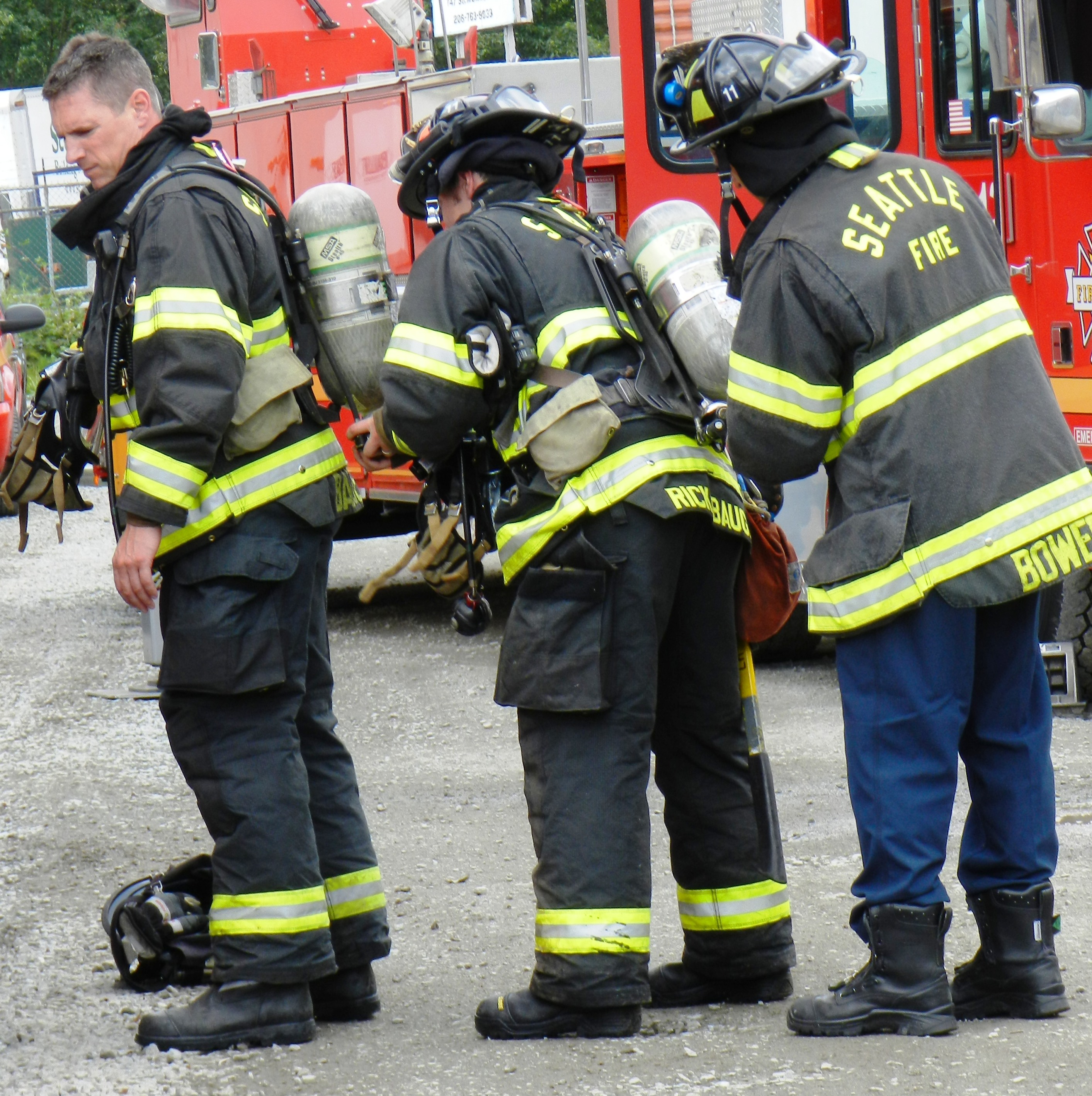
- Firefighter: Responsible for fire suppression, inspections, EMS responses, hydrant inspections, equipment maintenance, and other tasks as members of an operations ladder or engine company. May also be selected and assigned as a member of a specialty team such as technical rescue, marine firefighting, decon team, hazmat team, dispatch, etc. The SFD does not have a separate job class for the assigned drivers, they are most often the senior firefighter assigned to a company.
The Seattle Fire Department has at its head, the Fire Chief, or Chief of Department. Reporting directly to the Chief of Department are 4 Assistant Chiefs in charge of the following department divisions: Resource Management, Safety and Employee Development, Operations, and Fire Prevention/Fire Marshal.
Resource management
The Resource Management Division, commanded by the Resource Management Assistant Chief, is responsible for Finance (headed up by a civilian director), and Information Systems, Support Services, and Communications, each headed up by a deputy chief. The SFD Fire Alarm Center (FAC), or dispatch, is somewhat unusual in that it is staffed by firefighters instead of civilian dispatchers.
Safety and employee development
The Safety and Employee Development Division, commanded by the Safety and Development Assistant Chief, is responsible for Training (deputy chief), Human Resources (civilian director), Equal Employment Opportunity (civilian director), and the safety chiefs (4 battalion chiefs, one for each shift).
Operations
The Operations Division, commanded by the Operations Assistant Chief, is organized into 5 Operational Battalions and one Medic Battalion(Battalion 3). Each Battalion is commanded by a Battalion Chief. The Battalion headquarters are shown below, as well as what areas or districts of Seattle they command.
- Battalion 2– Fire Station # 25 – Downtown/Capitol Hill
- Battalion 3(Medic Battalion) – Medic One Headquarters – Harborview Medical Center
- Battalion 4– Fire Station # 18 – Ballard/Green Lake/Northwest Seattle
- Battalion 5– Fire Station # 13 – Rainier Valley/SODO
- Battalion 6– Fire Station # 17 – University District/Northeast Seattle
- Battalion 7– Fire Station # 29 – West Seattle
The SFD operates on a four platoon system with A, B, C, and D shifts. For each battalion there are 4 battalion chiefs, one for each shift. One battalion chief in each battalion is designated as the supervising chief of that battalion.
In addition to the supervision of the operations companies under their command, Battalion 7 is responsible for the Marine unit, including the Fireboats. Battalion 5 is responsible for the Heavy Rescue/Dive Teams. Battalion 2 supervises the Haz-Mat Unit.
The Battalion 3 chief oversees the Medic One program and department’s paramedics. This position is actually filled by a deputy chief that oversees all four platoons. The on duty medic supervisor is a lieutenant/paramedic and is designated Medic 44 (M44).
In addition to the on duty battalion chiefs there is an on duty shift commander in the rank of Deputy Chief that commands the Battalion Chiefs and the shifts of operations personnel under the command of the division’s Assistant Chief.
All operations division personnel work 24 hour shifts.
Fire prevention
The Fire Prevention/Fire Marshal Division, commanded by the Fire Prevention/Fire Marshal Assistant Chief commands the Sound Transit Deputy Chief, The Office of the Fire Marshal(Deputy Chief), Special Events(Captain) and Fire Investigation(Captain). [7]
Personnel profile(2010)
- 1,020 Personnel
- 208 On-Duty Strength
- 35 Department Chiefs
- 1,020 Emergency Medical Technicians (EMT) Certified
- 74 Paramedics
- 87 Non-Uniformed (Civilian) Personnel
Apparatus profile (2012)
- 33 Fire Stations (excludes Medic One Headquarters at Harborview Medical Center)
- 32 Engines
- 11 Ladder Trucks (1, 3, 4, 5, 6, 7, 8, 9, 10, 11, 12)
- 5 Battalion Chiefs (B2, B4, B5, B6 & B7)
- 1 Safety Chief (SAFT2)
- 1 Staff & ICS Support Unit (STAF10)
- 1 Deputy Chief (DEP1)
- 1 Command, Control & Communication Van (COMVAN)
- 4 Aid Units (BLS) (normal on-duty strength) (A2, A5, A14 & A25)
- 7 Medic Units (ALS) (M1, M10, M16, M18, M28, M31 & M32)
- 2 EMS/Paramedic Supervisors (M44 & M45)
- 3 Chaplain Units (CHAP3, CHAP5 & CHAP6)
- 2 Mobile Air Compressors (AIR240 & AIR260)
- 2 Air Bottle Units (AIR9 & AIR10)
- 4 Fire Boats (E1, E3, E4 and a reserve) (1 4-Person Crew)
- 2 Hose/Foam Wagons (HOSE18 & HOSE34)
- 1 Technical Rescue Unit (R1)
- 1 Reserve Technical Rescue Unit (R80)
- 1 Haz Mat Unit (HAZ1)
- 1 Reserve Haz Mat Unit
- 1 Mobile Ventilation Unit (MVU1)
- 1 Decontamination Unit (DECON1)
- 1 Multiple Casualty Incident Unit (MCI1)
- 1 Marine Incident Unit (U-99 or MARVAN)
- 1 Fire Investigation Unit (MAR5)
- 1 Public Information Officer (PIO)
- 1 Power/CO2 Truck (P-25)
- 1 Metropolitan Medical Strike Team Trailer (MMST)
- 1 Urban Search & Rescue Trailer (USAR)
Other units that may be heard over Seattle Fire Department Radio are either reserve units or rare units that aren’t in service always. Such as:
- TRN1 (“Training 1”)
- MM2 (Metropolitan Medical Chief # 2)
- 234 or 89 (Fire Chief / Assistant Chief of Operations)
- Many Reserve Engines, Ladders, Aid Units and Medic Units (Generally the units will be in an 80’s or 90’s number series)
The list below is fairly comprehensive and includes all first line apparatus. Some stations may have reserve apparatus that is not included on this list.
Reserve Battalion Chief’s units are designated by a repeating the digit of the battalion, i.e., Battalion 2’s Chief’s unit would be Battalion 2, thus the Reserve Battalion Chief’s unit would be Battalion 22).
The fire department is currently in the middle of remodeling and replacing many stations under the Fire Facilities and Emergency Response Levy. As such some of the addresses below will be changing or certain stations may have been moved to temporary quarters while their station is remodeled.
Sources:
- ^ Chris Casey (undated). “Seattle History”. Boulevards New Media. http://www.seattle.com/history/. Retrieved 16 December 2008.
- ^ James R. Warren (September 25, 2001). “Ten who shaped Seattle: Henry Yesler struck gold in lumber and real estate”. Seattle Post-Intelligencer. http://www.seattlepi.com/local/40153_yesler25.shtml. Retrieved 16 December 2008.
- ^ “The Great Seattle Fire”. University of Washington Libraries. undated. http://content.lib.washington.edu/extras/seattle-fire.html. Retrieved 17 December 2008.
- ^ Hugh McGough (undated). “The Great Seattle Fire—Don’t Blame Jimmie McGough”. http://www.magoo.com/hugh/fire.html. Retrieved 17 December 2008.
- ^ Casey McNerthney (2011-07-22). “The P-I error that changed Seattle history”. seattlepi.com. http://www.seattlepi.com/local/article/The-P-I-error-that-changed-Seattle-history-1531131.php. Retrieved 2011-07-30.
- ^ a b “Great Seattle Fire”. Digital Collections. University of Washington Libraries. 23 January 2007. Archived from the original on 2007-05-20. http://web.archive.org/web/20070520045115/http://content.lib.washington.edu/seattle-fire/index.html. Retrieved 2007-06-29.
- ^ Greg Lange (January 16, 1999). “Seattle’s Great Fire”. HistoryLink.org. http://www.historylink.org/index.cfm?DisplayPage=output.cfm&File_Id=715. Retrieved 17 December 2008.
- ^ Austin, Charles W.; H.S. Scott. “The Great Seattle Fire of June 6, 1889”. Washington State Genealogical and Historical Review (Spring, 1983): 41–72.
- ^ Austin & Scott, p. 45
- ^ Davies, Kent R.. “Sea of Fire”. Columbia Magazine (Summer 2001): 32–38.
- ^ MacDonald, Norbert (1987). Distant Neighbors: A Comparative History of Seattle and Vancouver. Lincoln, NE: University of Nebraska Press. pp. 33–38.
- ^ Ochsner, Jeffrey Karl; Dennis A. Andersen (2003). Distant Corner: Seattle Architects and the Legacy of H.H. Richardson. Seattle, WA: University of Washington Press. pp. 55–110.
Want to find out more about the Seattle Fire Department? They can be found at.http://www.seattle.gov/fire/.
(c) 2012 The NW Fire Blog
 NW Fire Blog
Comments are closed.