

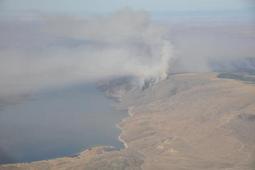
Incident: Buffalo Lake Road Wildfire
Released: 2 hrs. ago
Most of the Buffalo Lake Road Fire was quiet yesterday, giving firefighters the opportunity to continue improving containment lines and mopping up throughout its perimeter. In the southeast section, near Swawilla Basin, even with more fire activity, the rocky terrain made it difficult to thoroughly burn out the sparse fuels. Despite these challenges, crews located and built a new containment line that is closer to the body of the fire. This strategy will hasten successful containment.
Utility crews were able to access and repair burned powerlines enabling restoration of electricity to Mt. Tolman and the town of Keller.

Credit: WIIMT #4
All roads in the area including Peter Dan Road, Buffalo Lake Road and Hwy 155 are open. Drivers should use caution, watching for fire personnel and any rolling rocks or debris that has been loosened when the supporting plants and logs burned away.
Today’s weather is expected to exceed 100�F, with relative humidity of 11%. Although winds should generally be light, there’s a chance of dry lightning storms tonight. Crews are alert to the possibility of erratic winds as weather changes. Fire managers have created contingency plans for providing “initial attack” forces if needed in the area.
The current size of the wildfire is approximately 11,091 acres with 82% containment.
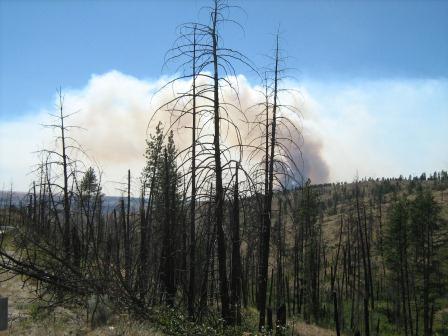
Credit: WIIMT #4
Coordination is occurring between the Colville Confederated Tribes, Bureau of Indian Affairs, Washington Department of Natural Resources, US Bureau of Reclamation, Okanogan Fire District 2, Elmer City Fire Department, Coulee Dam Fire Department, Grant County Fire Department, National Park Service and Okanogan County.
Colville Business Council Chairman: Quick Work By Emergency Fire Responders
Incident: Buffalo Lake Road Wildfire
Released: 13 hrs. ago
August 17, 2012
For Immediate Release
NESPELEM, WA – The Colville Tribal Business Council is grateful for the quick actions of the Colville Tribes’ emergency responders, as well as the efforts of local, state and federal agencies which helped to contain the Buffalo Lake Road Fire, CBC Chairman John Sirois said today.
“Without the immediate and well-coordinated actions of these emergency response teams, this fire could well have been more devastating than it was,” Sirois said. “While the loss of rangeland vegetation and trees to a wildfire is always regrettable, the quick response assured that there was no loss of life or extensive damage to structures in the fire’s path. We are very thankful for that.”
The fire began at the intersection of Buffalo Lake Road and Peter Dan Road at approximately 8 p.m. on August 14. Within minutes it spread, igniting dry grass and sage fuels, and roared downhill, threatening the communities of Elmer City and Coulee Dam. Tribal Fire & Rescue personnel worked under the Incident Command System (ICS) with local fire departments to provide structural protection to houses threatened by the blaze. As a result, no homes were lost.
“Firefighters and public safety officials from several jurisdictions worked together in an extraordinary effort that ultimately helped save the lives and property of people in the path of the blaze,” Sirois said. “This was an excellent example how we can work together in an emergency situation to protect our citizens and our communities.”
Tribal Emergency Management personnel coordinated with other agencies to assess the need for evacuation, and Tribal Police went door to door, notifying residents of the Level II (voluntary) evacuation, while Tribal Fire & Rescue personnel notified residents of the Level III (mandatory) evacuation at the fire’s point of origin. Law Enforcement also helped to establish road closure and provide traffic control to make sure evacuees were able to leave the area in a safe and orderly manner. Tribal Occupational Safety and Health Administration personnel assisted with road closures and resource coordination. Off-duty Tribal Corrections personnel were called in to support these efforts.
“Law enforcement officers stayed at the scene through the night to help protect the firefighters battling the fire,” Sirois said. “The Colville Business Council is very proud of the Tribal Emergency Response Team. Their professionalism continues to reflect positively on the Colville Tribes.”
Although the fire is estimated to have charred approximately 10,962 acres, “the dedication of all the emergency response teams paid off.” Sirois said.

“We are grateful for the efforts of everyone, from every agency, who did their utmost to assure that this destructive wildfire caused no significant losses of property or life left,” he said. “Lim limt-thank you all very much.”
For more information, contact John Sirois, 509-634-2212.
Firefighters’ Tough Fight Tames The Explosive Buffalo Lake Road Wildfire
Incident: Buffalo Lake Road Wildfire
Released: 13 hrs. ago
Firefighters’ tough fight tames the explosive Buffalo Lake Road Fire
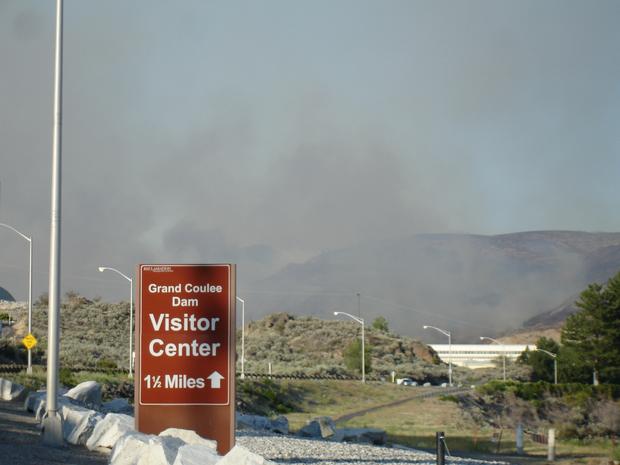
Credit: Washington Interagency Incident Management Team #4
Buffalo Lake Road Fire nearly contained; fire now burning itself out in a deep draw along northern perimeter and Roosevelt Lake
Nespelem, Wash., Nearly 200 firefighters worked in 100-degree heat today to locate and extinguish the burning fuels throughout the 11,000-acre Buffalo Lake Road Fire. After three days of firefighting in the rugged terrain east of the Columbia River and north of Lake Roosevelt, the fire containment is estimated to be 82% with a few remaining pockets of timber burning in the deep canyons along the northern shore of Lake Roosevelt.
According to Pat Halford, operations section chief for Washington Interagency Incident Management Team 4, those pockets of burning fuels are expected to burn themselves out within two days.
Halford said firefighters spent two days burning out the upper slope above the steep and craggy cliffs above the Lake, driving the fire toward the water’s edge. The strategy, he said, was to stop any spread north or east and allow the fire to consume remaining fuels there. “Lake Roosevelt is a popular recreation area and we want to make sure the fire cannot flare up later and alarm the public,” he said, “so crews are cleaning up the area from the blackened burn to the Lake where it can be done safely.”
Some of the smoke seen throughout the area during the past two days resulted from that burnout that was conducted in the southeast part of the fire, Halford said. In a steep draw in the north end of the fire, a 20-person hand crew and several engines worked to clean up the fire burning in old snag trees. “We expect to have that draw in good shape by the end of today,” he said.
Other crews spent today mopping up within 500 feet of homes and structures along the fire’s western perimeter – between the towns of Coulee Dam and Elmer City. “Infrared heat-detecting devices, called Palm IRs, are being used today and tonight to locate and extinguish heat that cannot be seen,” Halford said.
The power poles northeast of Coulee Dam burned by the fire will be replaced by 6 p.m., Halford said. With the installation of new poles, power is expected to be restored to the community of Keller, which has been without power for more than 25 hours.
Crews throughout all divisions of the fire have been mopping up and rehabilitating areas to standards developed by the Confederated Tribes of the Colville Reservation and the Washington Department of Natural Resources. “Control of the fire area will be returned back to the Tribes once the mop-up and turn-back standards have been met,” Halford said.
Halford said rocks and boulders throughout the burned-over area pose hazards now that the logs and vegetation that had been holding them in place have burned. “The public is encouraged to stay out of the area until it has been rehabilitated,” he said.
The fire started Tuesday, August 14 at the intersection of Peter Dan and Buffalo Lake Roads. The cause of the fire was determined to be lightning from a storm that passed through the area five days prior. The fire flared up and moved rapidly through dry grass, sage, and sparse ponderosa pine and Douglas-fir timber, driven by erratic winds. By Wednesday evening, the fire had burned across the slope above the town of Coulee Dam and was moving eastward until stopped by dozer lines through the Swawilla Basin.
Heroic work by initial attack forces, consisting of Tribal and fire department resources, on Tuesday saved hundreds of homes and outbuildings along Highway 155 north of Elmer City. A Level II Evacuation Notice was issued Tuesday night to residents of Elmer City and surrounding area. The area remains under a Level I Evacuation today.
While the fire burned through the area, Highway 155 was detoured along the Elmer City Access Road for two days as firefighters struggled to keep the fire away from the shore of the Columbia River. At one point, the fire did cross the Access Road, causing the complete closure of Highway 155 for nearly 10 hours.
As firefighters continue to mop up and hold onto the successes of the past four days, Halford anticipates a change in the hot, dry weather with an advancing thunderstorm late Saturday. “The storm is going to bring lightning. It’s less lightning than what we had anticipated, but we do not expect much precipitation with the storm either,” he considered.
The hot and dry weather currently affecting the region is expected to continue for the next several weeks with increased fire behavior in the late afternoons.
When asked how concerned he is about the anticipated dry lightning, Halford said, “We will have to wait to see what it gives us and deal with it accordingly.”
The Washington Interagency Incident Management Team (WIIMT) #4 is managing the fire under the command of Larry Nickey, incident commander.
More than 250 firefighting personnel have been very conscious of firefighting safety principles and are maintaining a stellar safety record. “To date, there have been only a few minor blisters,” Halford said. “We are striving to keep firefighters safe, both day and night, while battling this fire,” he added.
The Colville Confederated Tribe’s seven-member Burned Area Emergency Response Team is evaluating burn severity throughout the southern and eastern portions of the fire and developing a comprehensive plan for the rehabilitation of fire-damaged resources.
Fire Facts – Friday, August 17, 2012 – 1800 HOURS
Fire Size: 11, 091 Acres
Percent Contained: 82%
Fuels: Sparse timber, grass/understory/ bitterbrush, sage, slash, snags and down fuels in draws/canyons
Expected Containment: August 19, 2012
Air Resources:
Engines: 19
Dozers: 4
Water Tenders: 11
Overhead: 65
Total Personnel: 262
Total Estimated Cost to Date: $883,505
Peter Dan Road and Buffalo Lake Road Now Open
Incident: Buffalo Lake Road Wildfire
Released: 15 hrs. ago
As of 1800 on August 17, the Peter Dan Road and the Buffalo Lake Road have been re-opened. These roads were closed due to the Buffalo Lake Road wildfire activity and damage to powerlines in the area. The suppression of the nearby fire, and the repair of the powerlines, have enabled this popular route between Elmer City and Mt. Tollman to be safely re-opened. Travellers are encouraged to drive carefully because fire personnel continue to work in the area both day and night, and rocks and debris may have been loosened by the fire.
Phone: 509-634-2542.
 NW Fire Blog