

Published June 30, 2024, 1000 hours PT

ALWAYS REMEMBERED, NEVER FORGOTTEN
Today marks the 11th Anniversary of the 19 Granite Mountain Hotshots (hosted by the Prescott Fire Department) that would perish while fighting a wildfire in Arizona.
This is their story and the details of this firestorm, the sacrifices made and the people who lived through it. ALWAYS REMEMBERED, NEVER FORGOTTEN.
“It’s been 11 years and still not a day that goes by we don’t think about our Granite Mountain Hotshots. Please keep their families in your hearts today as we remember our fallen brothers, sons, fathers, friends, and family. May you all continue to rest in peace.” – AZ State Parks
INCIDENT SUMMARY
The Yarnell Hill Fire was sparked by dry lightning at 1736 hours on June 28, 2013, which started high on a ridge west of Yarnell on Bureau of Land Management (BLM) lands and about 80 miles northwest of Phoenix. Multiple fires started in several places.
On June 30, 2013, the winds began picking up and blowing over 22 MPH pushing the fire from 300 acres to over 2,000 acres. The fire behavior was considered in today’s terms as extreme with a rapid rate of spread, with wind-driven runs, running, and spotting. Fire weather helped the fire behavior to be erratic as temps were at 101*F.
TIMELINE OF THE FIRE
Here is a timeline of the wildfire incident according to Fire Officials on Social Media:
June 28, 2013. Several parties notify the Arizona Dispatch Center (Dispatch) of a lightning-ignited fire
on State of Arizona land west of Yarnell at about 1730 on June 28. It is one of four fires on
state lands in the vicinity caused by significant lightning activity.
Dispatch begins documenting the incident at 1736 as the Yarnell Hill Fire. An Arizona State Forestry Division (AZSF) firefighter, a qualified Type 3 Incident Commander (ICT3) who has worked in the local area since 1995, coordinates responses to the lightning strikes. He and the BLM Duty Officer on the scene anticipate multiple new lightning-caused fires in the morning.
The AZSF firefighter asks Air Attack to fly the general area around Yarnell to confirm there are no additional fires. The Air Attack assigned to the Doce Fire, flies over Yarnell Hill initially had difficulty finding the fire due to a lack of smoke. Once he spots it, he reports the fire is in a boulder field, has no vehicular access, and shows very little smoke. He spots no additional fires. They schedule another reconnaissance flight for the following morning.
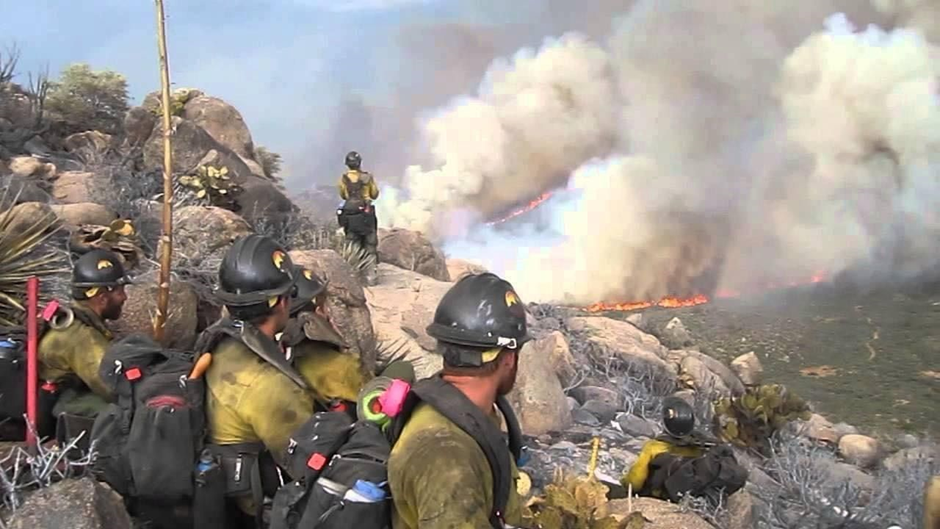
(R) Photo texted by Hotshot Wade Parker at 1604 hours PT on June 30.
At 1940, the AZSF firefighter becomes the Type 4 Incident Commander (ICT4) for the Yarnell Hill Fire. On initial assessment, ICT4 notes the fire is less than a half-acre in size, 80 % out, active only in one corner, with low spread potential and no structures or people at risk. He notes the fire is in a steep, rocky area on a west-facing slope. ICT4 is concerned about firefighters moving across the rugged terrain at night, and he knows he cannot provide logistical support for them overnight. He is also concerned about potentially exposing firefighters to lightning on the ridge.
In consideration of these factors, the relatively low fire behavior, and the attention required by other fire starts, he prepares to begin full suppression efforts on Yarnell Hill the following morning. He requests two Type 2 Department of Corrections crews, a light helicopter, and an AZSF engine for the morning.
The Hotshot’s Prayer:
When I am called to duty, Lord
To fight the roaring blaze,
Please keep me safe and strong
I may be here for days.
Be with my fellow crewmembers,
as we hike up to the top.
Help us cut enough line,
For this blaze to stop.
Let my skills and hands
be firm and quick.
Let me find those safety zones,
as we hit and lick.
For if this day on the line,
I should lose my life,
Lord, bless my Hotshot Crew,
my children and my WIFE.
– Patricia Huston
June 29, 2013. ICT4, the BLM Duty Officer, and an ICT3-qualified BLM Representative together coordinate tactical response on the fire the morning of June 29. They had been planning to address new fires in multiple jurisdictions that morning but the Yarnell Hill Fire is now the area’s only active fire resulting from the June 28 lightning ignitions. ICT4 asks the BLM Representative to remain engaged with him that day.
ICT4 assesses the fire and then reports to Dispatch that little smoke is showing and they will drop retardant to hold the fire until crews arrive. At 0651, he requests two Single Engine Airtankers (SEATs). They arrive mid-morning and drop fire retardant on the south and west flanks until about noon, each making two retardant drops. These SEATs initially work out of the Prescott Airtanker Base while the closer Wickenburg Base, being a Call When Needed (CWN) operation, takes the necessary four to six hours to prepare for operations.
Just before 1100, a BLM helicopter transports seven firefighters to within ¼ mile of the ridge. The one helitack and six Department of Corrections firefighters hike in the rest of the way to construct handling.
Air Attack and the SEATs return to Prescott by 1225, after Air Attack reports retardant is securing the south and west flanks of the fire, the north flank is a ridge, and a two-track road is securing the east flank. The fire size is about two acres. While on the ground at Prescott, Air Attack and the SEATs refuel.
The fire is holding on all four sides and none of the other starts from the day before shows smoke. At 1442, ICT4 advises Dispatch he is releasing an Air Attack. At 1540, he releases the BLM brush engine and a local Peeples Valley fire engine, because the multiple fire starts he had expected do not materialize. ICT4 releases the two SEATs for new assignments and the State of Arizona Aviation Officer orders them to reposition to the Wickenburg SEAT Base.
Weather conditions are hot and dry, and increasing west-southwest winds elevate fire activity at around 1600. ICT4 responds at 1610 by requesting the two SEATs and Air Attack to return to the Yarnell Hill Fire. One SEAT and Air Attack launched from Wickenburg but the second SEAT stands by for potential new fire starts from active lightning across central Arizona.
The fire eventually jumps the two-track road on the east flank and grows to about six acres by late afternoon. ICT4 tells Dispatch they are having problems catching the fire, and he orders a Type 1 Heavy Helitanker and Large Airtanker (LAT). At around 1730, ICT4 requested an ICT3 and the State of Arizona Incident Management Team (IMT) to take the fire in the morning, voicing concerns about potential threats to Peeples Valley and Yarnell if the fire burns to the northeast in the next 24 to 48 hours.
Dispatch informs ICT4 at 1742 that the Heavy Helitanker and the LAT declined the resource orders because of high winds and severe weather en route from their locations. A few minutes later, Dispatch tells him a Very Large Air Tanker (VLAT), a DC-10 with an 11,400-gallon capacity, is available and can take off from an airport unaffected by the weather. ICT4 discusses the option of Air Attack over the fire and with the BLM Representative. ICT4 declined the VLAT offer at 1750 based on fire conditions.ICT4 continues to use the SEATs to drop retardant.
The operational tempo and complexity continue to escalate. The fire grows throughout the evening to an estimated 100 acres, prompting ICT4 to change his request for an ICT3 to a Type 2 IMT. Dispatch fills the order with the Arizona Type 2 short IMT.
ICT4 also notifies the Yavapai County Sheriff’s Office (YCSO) to prepare for reverse 911 calls in case evacuations become necessary, and he requests additional resources for the next day including 14 engines, six water tenders, two Type 2 crews, two bulldozers, and numerous aircraft.
ICT4 also asks for two structure group specialists, one for the north end (Model Creek, Peeples Valley) and one for the south end (Yarnell, Glen Ilah), and he requests three IHCs. Dispatch orders the IHCs through the Southwest Coordination Center (SWCC), one of the nation’s interagency Geographic Area
Coordination Centers. SWCC fills two of the orders with the Blue Ridge IHC and the Arroyo Grande IHC but advises Dispatch to rescind their order for the third crew and fill it internally with the local Granite Mountain IHC.
By 1924, the fire is spreading actively in chaparral to the north-northeast (Figure 3). The Stanton Remote Automated Weather Station (RAWS) indicates a temperature of 101O F and relative humidity of 12 % with sustained winds of 10 miles per hour (mph) gusting to 20 mph out of the south-southwest. Assessing the fire behavior from the air is difficult but flame lengths appear to be 10 to 20 feet with rates of spread of 5 to 10 chains per hour.
The Structure Protection Group 1 Supervisor (SPGS1) arrives at about 2340 and is assigned structure protection for Yarnell. He drives the roads to learn the town, heading into the hills on backcountry roads, tying in with personnel on the fire, and looking for strategic options for protecting Yarnell. He sees overgrown yards and indefensible houses, and he recognizes there are limited options for a protection strategy. Although the fire appears in check, he thinks it could come down the hill during the next burn period. He spends the night building his situational awareness and developing contingency plans. As one contingency, he considers how to tie roads together to burn off vegetation if needed to protect Yarnell.
That night, 13 firefighters remain on the hill while other resources (ICT4, BLM Representative, BLM Duty Officer, two structure group specialists, and four engines) remain in the Yarnell and Peeples Valley areas.
June 30, 2013. At the 0700 briefing on June 30, ICT4 and others from the previous shift meet at the
Yarnell Fire Station with incoming personnel including ICT2, two Operations Section Chiefs (OPS1 and OPS2), SPGS1, a fire behavior analyst (FBAN), YCSO deputies, and the Granite Mountain IHC superintendent. The briefing covers strategy and tactics, the previous night’s spot weather forecast, and
radio frequencies. They review the area using Google Maps on an iPad, and they note Boulder Springs Ranch as an excellent safety zone.
Photo Credit: AZ State Parks
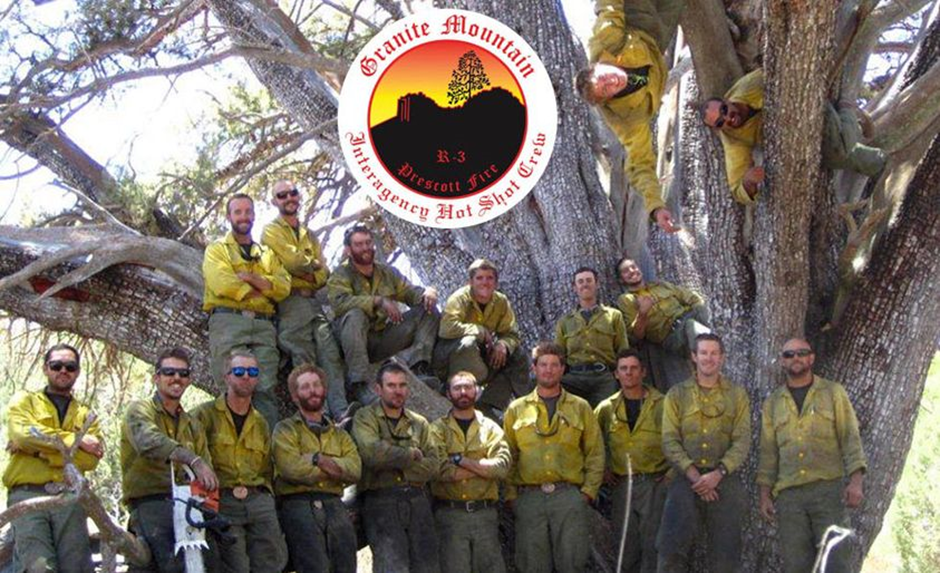
They establish the command channel setup and communications plan for the incident. As part of the leader’s intent, they also, discuss strategies for the north side of the fire and for keeping the fire, now estimated at 300 to 500 acres, out of Yarnell by improving old roads, taking advantage of previous fuel mitigation work, and constructing some new dozer line to backfire if necessary. They lay out a strategy to establish an anchor on the south end. They also agree the Granite Mountain Superintendent will become Division Supervisor Alpha (DIVS A) and his Assistant Superintendent (Granite Mountain Captain or GM Capt) will run the crew. DIVS A’s assignment is to establish an anchor point at the heel of the fire, using direct or indirect tactics as appropriate.
As additional resources arrive, they assemble at the Model Creek School in Peeples Valley, designated as the Incident Command Post (ICP). Incoming resources receive a communications plan, have their radios cloned, and receive operational assignments. ICT4 and the incoming Type 2 Incident Commander (ICT2) conduct a briefing starting around 0930 at the ICP. The formal transfer of command is announced by radio at 1022.
Firefighters had to deploy their fire shelters during their entrapment, but the heat of the wildfire was over 2,000 *F. Some of these firefighters were not found in these fire shelters.

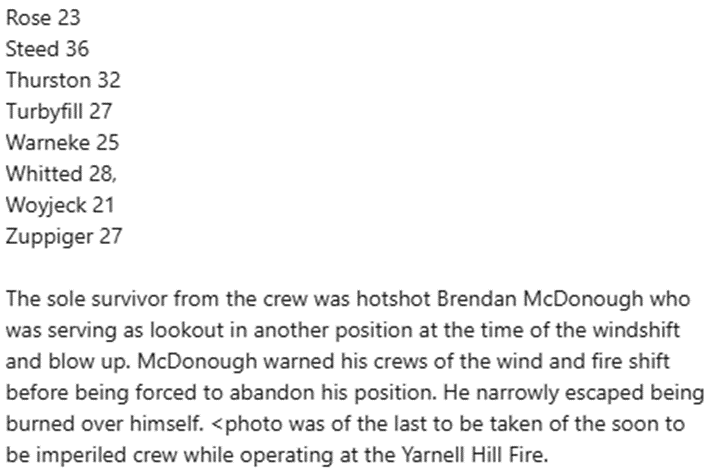
July 1, 2013. The Yarnell Hill Fire is listed at 8,400 acres and has a 0% containment status. This becomes the number #1 priority fire across the United States, nationwide.
July 2, 2013. Community meetings are starting to happen to give fire updates to residents, news agencies, the public, and the world captivating a focused audience begging to know what is happening in the State of Arizona. Crews are starting to get a hold of the firestorm and now reaching an 8% containment status. An Investigation into the cause of the fire begins.
July 3, 2013. Media and travel advisories are issued. A fire map is released by the PIO. A severe weather advisor is issued for the fire area. Firefighters’ information and donation site is established. The fire is now at 45% containment.
Photo Courtesy: iawfonline.com
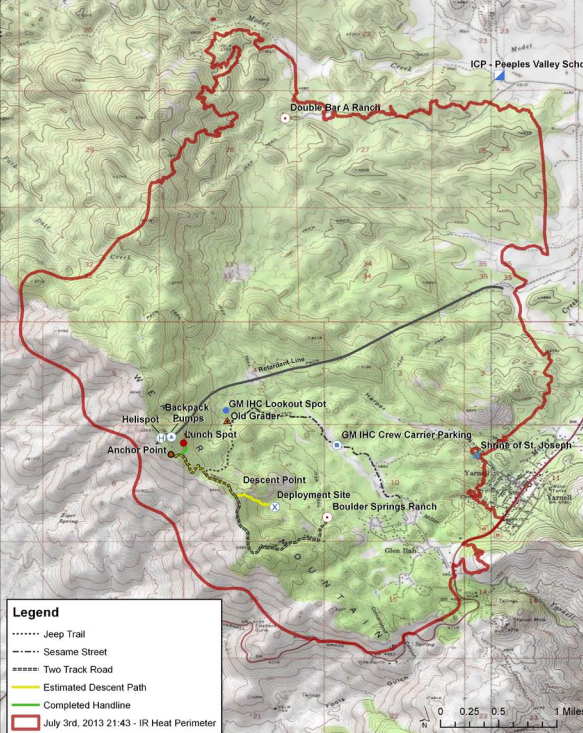
July 4, 2013. A community meeting takes place on this day at Wickenburg High School at 1100 hours. Media is escorted to the helibase for a tour and a rare opportunity to see their firefighters working. Evacuation orders are lifted for the Peeples Valley community at 1830 hours. A Granite Mountain Hotshots Memorial information is shared. Residents begin the re-enter their communities. Fire is now at 80% containment status.
July 5, 2013. The Yarnell Fire Department hosts a community meeting at Wickenburg H.S. at 1100 hours. A website is created for the Yarnell 19 at yarnellfallenfirefighters.com (now a broken and not working site). The Yarnell Hill Fire Joint Information Center (JIC) opens.
July 6, 2013. The fire is now at a 90% containment status. Fire Managers: “Out of respect for the families of the fallen firefighters the area at the Fairgrounds will be closed to the public on July 7, 2013.”
July 7, 2013. An update is given from the Granite Mountain Hotshots Memorial IMT. The fire remains at a 90% containment status.
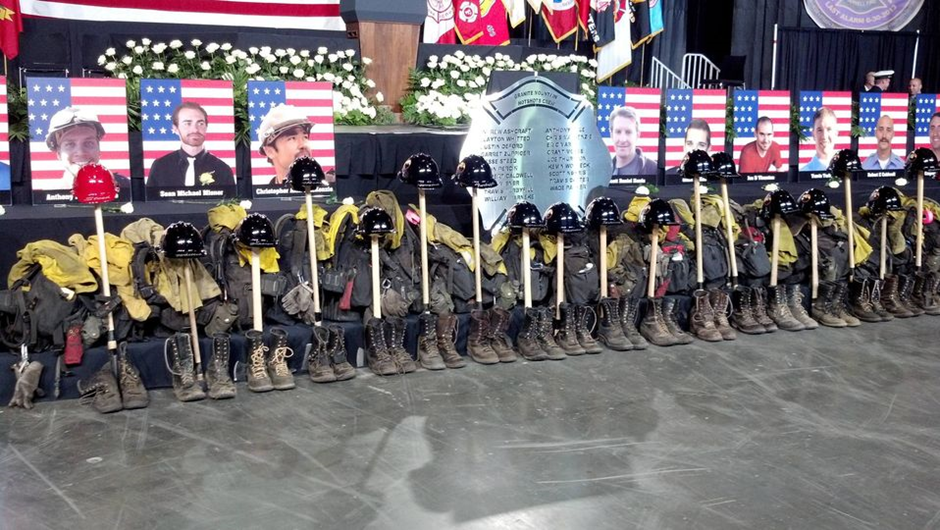
July 8, 2013. Yarnell residents are cleared to re-enter their communities, as the Yarnell Hill Firefighters focus on honoring their fallen brothers.
July 9, 2013. Governor Brewer requests Disaster Declaration for Yarnell Hill Fire. Bacterial testing sites are available for private drinking water wells in Yarnell fire-touched communities. Individual Assistance Center opens.
July 10, 2013. The fire is 100% contained on this date.
EVACUATIONS
A minimum of 600 people were under mandatory evacuations and a shelter was established and staffed by the American Red Cross at the Yavapai College in Prescott. A second shelter was set up at the Wickenburg High School near Wickenburg because the closure of SR 89 made it impossible for some people to reach the Prescott shelter. About 351 total people stayed in either of the open shelters.
By July 1st, the fire had burned about 8,400 acres, which prompted the mandatory evacuations of the nearby community of Peeples Valley. The fire was still considered as being out-of-control with over 400 firefighters working to try to contain this firestorm.
DAMAGE ASSESSMENTS
According to the Yavapai County Sheriff’s Office, there were 127 buildings in Yarnell and two in Peeples Valley that had been lost, for a total of 129 structures.
There was $900 Million in damage.
FATALITIES
19 Granite Mountain Hotshots.
INJURIES
23 non-fatal injuries.
AFTER ACTION REPORTS
Following a three-month investigation, the state’s Forestry Division released a report and briefing video on September 28, 2013, which found no evidence of negligence nor recklessness in the deaths of the 19 firefighters and revealed that an air tanker carrying flame retardant was directly overhead as the firefighters died. The investigation did find some problems with radio communications due to heavy radio traffic and the fact that some radios were not programmed with appropriate tone guards.
According to Wikipedia, this has been considered one of the deadliest U.S. wildfires in history since the 1991 Oakland Hills Fire which killed 25 people, and the deadliest wildland fire for u.S. Firefighters since the 1933 Griffith Park Fire which killed 29 “impromptu” civilian firefighters drafted on short notice to help battle the Los Angeles Fire. This is considered the sixth deadliest American firefighter disaster in history and ever for the State of Arizona (at least until 2014).
On December 4, 2013, the Industrial Commission of Arizona, which oversees workplace safety, blamed the state’s Forestry Division for the deaths of the 19 firefighters, based on an investigation by the state’s Division of Occupational Safety and Health. The Commission said that state fire officials knowingly put the protection of property ahead of safety and should have pulled crews out earlier. The commission levied a $559,000 fine.
SOURCES
Investigational report. https://web.archive.org/web/20150713214407/http://www.iawfonline.org/Yarnell_Hill_Fire_report.pdf
Wikipedia
(c) 2024 NW Fire Blog
 NW Fire Blog